Saturday, November 11, 2017

Monday, November 13 quotation review


quotation mark
noun
  1. each of a set of punctuation marks, single (‘ ’) or double (“ ”), used (1) either to mark the beginning and end of a title or quoted passage or (2) to indicate that a word or phrase is regarded as slang or jargon or is being discussed rather than used within the sentence.
The previous assignment on leads was for two days (Wednesday and Thursday last week), but only about a third of you already completed it. It is late now and worth only 50 points. 

   All marking quarter grades have been submitted to central office. Late work impacts your grades, and, of course, no work means a zero. Today's work is DUE AT THE CLOSE OF CLASS, after which it is worth only 50 points. Since your old work is already late, please complete this assignment to get it in on time.  


ASSIGNMENT TODAY:  The next step after writing your news lead is inserting a quotation. Let's begin by reviewing the rules for quotation usage.  Note particularly the use of a quote within a quotation! Please take your time to read the following. When you have finished there is a practice exercise. Please complete and send along. 
   
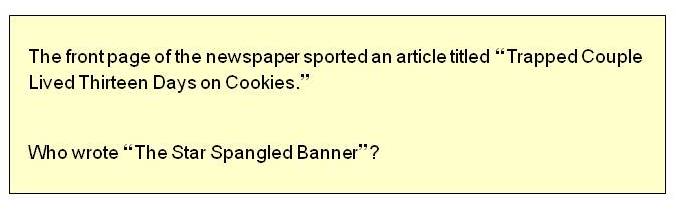
1. To enclose titles of minor works: articles, essays, poems, songs, chapters of 
books, short stories, episodes of radio/TV programs.
    
Examples


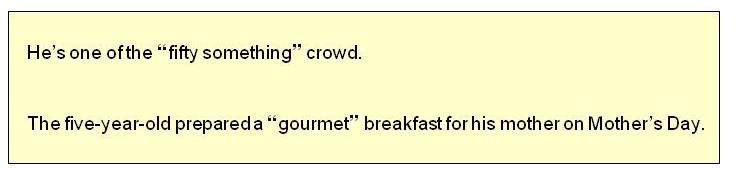
2. To enclose  words used ironically or where the term so-called could be inserted.
Examples


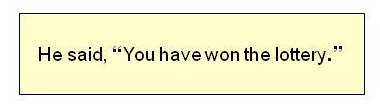
3. To enclose a direct quotation:   a person's exact words
   
             Example
     
   
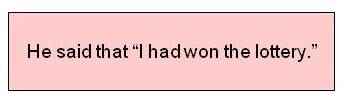
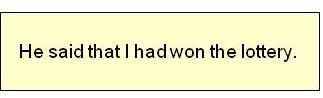
NOTE:  Do not use quotation marks to enclose indirect quotations.   
           Incorrect


           Correct


NOTES FOR DIRECT QUOTATIONS:
    
1. Start the quotation with a capital letter.
2. Place commas and periods INSIDE the quotation marks.
3. Place semicolons and colons OUTSIDE the quotation marks.
4. Place question marks and exclamation marks INSIDE the quotation marks if the quotation itself is a question or an exclamation.

5.  Place question marks and exclamation marks OUTSIDE the quotation marks if the quotation itself is NOT a question or exclamation.


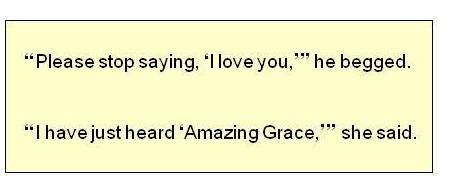
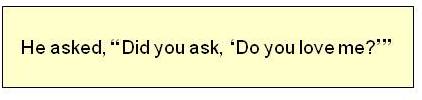
USE SINGLE QUOTATION MARKS to enclose a quotation inside another quotation.
     

Examples


If the quotation within another quotation is a question or an exclamation, place appropriate punctuation next to the item concerned.

            Examples

Question quotation inside statement quotation 
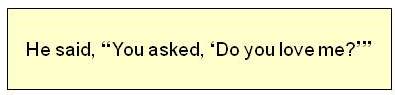


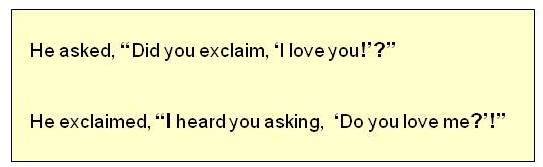
Statement quotation inside question quotation
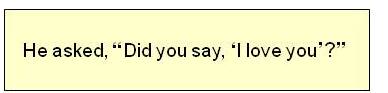


Question quotation inside question quotation 

Exclamation quotation inside question quotation
                                                 or
Question quotation inside exclamation quotation

Webapps.towson.edu, webapps.towson.edu/ows/punct2.aspx#quotation_marks.


Please rewrite the following sentences, inserting quotation 

marks and other punctuation as needed. READ CAREFULLY.


1.  Did you see that new movie asked my friend 


2.  When she saw his new Mercedes, she exclaimed What a beautiful car


3.  I just finished reading Shirley Jackson's short story The Lottery


4.  Did Jack really say It's not my responsibility


5.  The composer asked if the orchestra would play this Thursday


6.  I'm going to the newsstand he said for a copy of the newspaper 


7.  You're out of your mind exclaimed Tony, slamming the door


8.  The professor asked When was the treaty signed


9.  The mayor promised that the project would be completed in two months


10.  The Wasteland is a poem by T.S. Eliot


  11. Paul asked Did you read Keat's poem Endymion 


12.  Do you remember Joe asking Is anybody here she asked 


13.  Shall I read aloud Milton's poem On His Blindness she asked


14.  Weren't my exact words We all heard Harry yell Help


15.  I enjoyed the poem The Love Song of J. Alfred Prufrock said Harold


16.  What did Joe mean Mary asked when he exclaimed She's gone 


17.  Do you think that The Star Spangled Banner is hard to sing he asked


18.  The conductor said I want you to sing Schubert's Ave Maria


19.  The conductor said I want you to sing Schubert's Ave Maria


20.  We all heard Alfred say Bill asked Who is the new president of the organization


Wednesday, November 8, 2017

Wednesday / Thursday November 8 / 9 rewriting news leads

“The most important sentence in any article is the first one. If it doesn’t induce the reader to proceed to the second sentence, your article is dead.” — William Zinsser, On Writing Well

Before you begin this assignment, take a few minutes to read the following articles, noting specifically the length of a lead!


1. Trump, Putin to meet and discuss North Korea


Tokyo (CNN)President Donald Trump will seek to enlist his Russian counterpart Vladimir Putin this week on a mission to confront an increasingly truculent North Korea during their second face-to-face meeting.
Trump said aboard Air Force One as he winged toward Japan on Sunday that he expected the sit-down to occur on the sidelines of a summit for Asia-Pacific leaders in Vietnam, which is due to begin Thursday.

The talks will come as the investigation into Trump's ties to Russia's 2016 election meddling heats up back home. Before Trump departed for Asia, three of his campaign aides were ensnared in the probe led by special counsel Robert Mueller. During their first meeting in July, Trump did raise the issue of Russia's interference, though since then he's called the notion that Russia worked to sway the vote in his favor a hoax.

2. Saudi anti-corruption sweep leads to high-profile arrests

Directions: Open up a word document. Follow the instructions for each of the sections below, where you will rewrite the eleven leads.  Send along, as usual.  These are due by the end of class on Thursday, November 9


Part 1: Condensing lengthy leads
Condense each of these leads to no more than two typed lines of no more than 20 words.

 1. Roger Datolli, 67, of 845 Conway Road, a retired attorney and husband of Mayor Sabrina Datolli, who is serving her fourth term as mayor, was injured in a three-vehicle accident Thursday afternoon around 3:20 p.m. at the intersection of Warren and Davidson avenues, suffering a broken leg and several broken ribs when the car he was driving was struck broadside by a pickup truck driven by Jerry R. Harris, 31, of 2245 Broadway Ave., and then was pushed into the path of another vehicle.

2The city Planning and Zoning Commission met Thursday for its regularly scheduled  meeting and voted 3-2 to approve a joint plan by the city's Council of Government and the local Chamber of Commerce to renovate the core downtown business district by building a convention center and sports arena complex that will serve as a site for business meetings and conferences as well as possibly host a minor league hockey team on the Olympic-size ice rink planned for the site.

Part 2: Rewrite the following leads using the normal word order: subject, verb, direct object. Avoid starting the leads with a long clause or phrase. You may want to divide the lead into a couple of sentences. Correct any errors.

1.Wondering whether or not it was legally possible and if they could muster enough votes to support their desire to see changes implemented in the downtown historic section of the city, city council members Sandra Gandolf and Alice Cycler at the regular monthly city council meeting raised the issue of having the city's planning and zoning commission look into the possibility of creating a local board to oversee changes to buildings within the six-block downtown historic district.
2. Because the victim contributed in large measure to his own death by refusing medical attention that might have saved his life after the incident, James K. Arico, the 47-year-old man accused of stabbing him in the chest during an argument seven months ago, was allowed to plead guilty to assault today and was sentenced to six months in the county jail. He had been charged with murder.

Part 3. Rewrite the following leads, emphasizing the news, not the attribution*. Limit the attributions to a few words and place at the end, not at the beginning of the leads. 

Attribution is stating who said something. Attribution is essential to all of the media, including radio and television. Readers or listeners need to know who is speaking or the information came from. 

1. At a news conference held at the Department of Energy in Washington, D.C., Monday afternoon the head of the agency told reporters that the Senate's approval of a plan to dump nuclear waste material in the Nevada desert near Las Vegas  will provide a safe haven for  more than 77,000 tons of radioactive waste.

2. Tracy Tibitts, Lisa Drolshagen and Dorothy Brayton, all members of the Delta Delta Delta sorority at Iowa State University, appeared in a local courtroom this morning and testified that the defendant, Steven House, appeared drunk when he got into his car to leave the party moments before he struck and killed the pedestrian.

Part 4: Rewrite the following leads in a single sentence, correcting errors if necessary. 

1. Mildred Berg, the former president of City College, is a professor of economics at the college now. Berg got a call Monday from David DeBecker, president of the Harrison County Board of Education. BeDecker offered Berg the job of superintendent of Harrison County Schools, a position Berg interviewed for two months ago.

2. At 10:41 a.m., two police detectives saw two men enter Barneys Liquor Mart in the Oak Hill Shopping Center. The shopping center is located in the 1300 block of Oak Hill Avenue. The men were acting suspiciously. When the detectives entered the store to investigate, they saw one of the men pointing a gun at the clerk and the other taking money from the register. The officers pulled their weapons and shot the man with the gun. There have been seven robberies at the shopping center in the past month.

Part 5. Stressing the unusual. Rewrite only the lead for each of the following stories, correcting errors if necessary.

1. Daniel J. Silverbach is a policeman in your community. Last year, because of his heroic rescue of seven persons held at gunpoint during a robbery, Police Chief Barry Kopperud named him the departments Police Officer of the Year. Kopperud fired Silverbach when he reported for duty at 7 a.m. today. The department adopted certain grooming standards, and Kopperud said Silverbachs mustache was a quarter inch too long and his sideburns a half inch too long, and he refused to trim them. Kopperud added that he warned Silverbach a month ago to trim his hair, then ordered him to do so at the first of last week. He fired him for failing to obey the order of a superior officer.   

                                                                             
     2. Terri Snow of 3418 Hazel St. is a nurse at Mercy Hospital. She is married to Dale Snow, a former eighth-grade science teacher at Mays Junior High School. Snow was crippled after a diving accident three years ago, when his arms and legs were paralyzed. He met his wife at the hospital, where he was a patient, and they were married last month. Now state officials have suggested that they get a divorce. Before his marriage, Snow received $345 a month from the states Department of Social Services and a monthly $792 federal Supplemental Security Income payment. Because of his wife's income, he is no longer eligible for the payments, and the couple says without the payments they cannot afford to pay for Snows continuing medical treatments and special diet. State officials have advised them that Snow will again become eligible for the aid if they get a divorce. The officials refused to talk to reporters, however.


 3.Cremation is rising in popularity. Nearly 30 percent of the people who die in your state are now cremated. The Funeral Directors Association in your state met at noon yesterday and discussed a growing problem. The ashes of nearly 50 percent of those people they cremate are never claimed by family members, friends or anyone else, so they are stored in the funeral homes, and the directors want to dispose of them but are uncertain of their legal right to do so. They voted to ask the state legislature to pass a bill that spells out disposal procedures. The bill they propose would require funeral homes to make every effort to settle with the family of the deceased the desired disposal method. Families would have up to 90 days to pick up the remains or to specify what they want done with them. After 90 days, the funeral homes would be free to get rid of them either by burying them, even in a common container (in a properly designated cemetery) or by scattering them at sea or in a garden, forest or pond.


Sunday, November 5, 2017

Monday Tuesday November 6 /7 evaluating leads

Evaluating Good and Bad Leads


“The most important sentence in any article is the first one. If it doesn’t induce the reader to proceed to the second sentence, your article is dead.” — William Zinsser, On Writing Well


Assignment: 

Open a word document and copy the fifteen leads below. Under each, please evaluate and explain why or why not each is effective. What works? What flaws do you observe? I suggest that you first refer back to your responses from Thursday / Friday's reading/ questions  Things to consider:type of lead, voice and word choice.  (This will count as a writing grade, as the material is based upon the previous work. 

Please send along by midnight.
  1. A Baptist minister was convicted of drunken driving Tuesday and sentenced to 30 days in jail after a jury saw a police video of his failed sobriety test.
  2. Police Chief Barry Kopperud is concerned about juvenile crime in the city.
  3. During a press conference in her office at 8 a.m. today, Mayor Sabrina Datolli spoke about the city's need for more parks.
  4. With no debate, the City Council passed an ordinance Thursday to help fight crime by installing more street lights in three neighborhoods.
  5. Loans become popular way for students to conquer costs of college.
  6. The campus is home to a variety of stray and wild animals.
  7. Four years ago AIDS victim Edwin Jimenez, 22, learned he had only six months to live.
  8. Do not cross off Dec. 1 in your countdown toward Christmas. Instead, make plans to attend World AIDS Day on the Campus Green.
  9. A panel of seven local journalism professionals discussed important media issues, including the role of the press, at the university Tuesday.
  10. The week of Homecoming will be filled with numerous activities and freebies for students.
  11. The right to bear arms may soon be taken away from anyone who steps onto public school grounds in the city.
  12. A teen-age driver lost control of her car Tuesday night, paralyzing herself and killing a passenger. A 16-year-old riding in the back seat walked away only scratched and bruised.
  13. Around 3 p.m. Friday a bank on Hillcrest Avenue was the scene of a daring daylight robbery and shooting.
  14. Courses taught online offer an alternative to the traditional college classroom learning experience.
  15. One year ago an accrediting agency criticized the college for using too many adjuncts (part-time faculty members). Since then, the college has reduced its number of adjuncts from 769 to 749.

Thursday, November 2, 2017

Thursday Friday November 2 / 3 what are leads?


We are working on the fundamentals of how to write a news story. Please read the above  picture to anchor yourself. In order for you to write an effective news story, you must have an understanding of how to write a lead. Below you will find detailed information.

So that you read carefully- and to emphasize the salient points of lead writing- please respond to the following questions. You, of course, may copy and paste as you read.  This is due by the close of class tomorrow, unless you receive the extended time.

News leads questions:
1. Write two words that rhyme with the correct pronunciation of lead.
2. How long is a lead?
3. What is a typical lead called?
4. What is the purpose of a lead?
5. What are the two parts of a news story?
6. What is the function of the body of the story?
7. How is the body of a story constructed?
8. List the 5 Ws and the H.
9.  Which of the above should ideally be addressed in the lead?
10. What is a news peg?
11. What is a whammy?
12. What does it mean to "feature the feature"?
13. What types of nouns and verbs should a lead have?
14. How many words should one find in a lead?
15. Name three things not found in a lead.
16. For the most part, how many sentences should one find in a lead?
17. How does one determine what is featured in the lead?
18. What does a name lead feature?
19. What does an event lead feature?
20. What type of voice requires that the subject of the sentence act?
21. What does a cause lead feature?
22. What does a place lead feature?
23. What are the two most used opening features for leads?
24. What are the two least used features for leads?


Lead
Writing

The opening of a news story is called the lead (pronounced lede). It is usually one paragraph, and is usually only one sentence. The typical lead is called a summary lead or straight summary lead, and it, of course, summarizes the story; in other words, it tells the entire story in miniature as specifically as possible. Your job as a journalist, therefore, is to write a clear, fairly short sentence that reveals all, telling the end result of the story. Someone should be able to read the lead and be informed about what happened without reading the rest of the story.

news story essentially has two partsthe lead, which gives the gist of the story, and the body, which adds details and expands on information given in the lead. The body is written in inverted pyramid style: short paragraphs in descending order of importance.We'll be analyzing news stories for their  inverted pyramid style.


The All-Important Lead
A summary lead should answer two or more of the 5W's and H: who, what, when, where, why and how. Include those that are important to inform the reader. Usually, however, the lead will include, as a minimum, the who, what and when.

In deciding what to include in the lead, ask yourself:
1. What is the first question a reader would ask?
2.  What is the first thing you would tell another person about the situation or event? This is often called the news peg; it is the reason for doing the story, that aspect that makes an event or occurrence newsworthy.

Your lead might also focus on what journalists call the whammy, which is the fact or facts that make the story unique.

When writing the lead, you should attempt to feature the featurewhich means to put the most important aspect or main point first in the paragraph. Grab the reader's attention with the news immediately, without making him or her read through introductory words to find out what happened. This isn't radio or television news, where the reporter may slide into the heart of the story after an introductory sentence or two, which may be necessary so the listener will not miss important information. The written news story needs no such prompt, and if you slide into the story slowly you'll lose your reader. Newspaper readers expect to be informed about what happened immediately -- no beating around the bush.

Leads should:

 open with bright, interesting, colorful nouns and verbs
 be brief (often only 20-30 words)
 be, for the most part, one sentence in length
 be crisp and to the point
 effectively summarize the story
 "feature the feature"
 include attribution (the source) if needed for credibility
 give the title for any person mentioned
 not include personal pronouns such as "we" and "you"
 not include reporter opinion


FEATURE THE FEATURE

Depending on what you decide is most important, any one of the 5W's or H could be featured, which means it is placed first in the opening sentence.

Take a look at the follow facts:

Who:Washington television station
What:withdrew from a project to construct a 1,200-foot television transmitting tower
When:today
Where:in Silver Spring
Why:declining revenues
How:board of directors decided

The lead might read:
A Washington television station announced its withdrawal today from a project to construct a 1,200-foot television transmitting tower in Silver Spring.

Which ever of the 5W's is mentioned first is featured in the lead.

1When the who is featured, it is called a name lead. The example above is a name lead. It features the Washington television station.
2When the what is featured, it is called an event lead.
Withdrawal from a project to construct a 1,200-foot television tower in Silver Spring was announced today by a Washington television station.
This lead, however, is awkward because it is in passive voice; in other words, the one doing the action (the Washington television station) is at the end of the sentence as the object. Active voice requires that the subject of the sentence act, which means placing it first in the sentence, as in the first first example. We'll talk more about active/passive voice in a later activity.
3
When the when is featured, it is called a time lead.
Today a Washington television station announced its withdrawal from a project to construct a 1,200-foot television transmitting tower in Silver Spring.
4
When the where is featured, it is called a place lead.
A Silver Spring project to construct a 1,200-foot television transmitting tower was canceled today by a Washington television station.
This, too, is passive rather than active voice.
5
When the why is featured it is called a cause lead.
Because of declining revenues, a Washington television station announced its withdrawal today from a project to construct a 1,200-foot television transmitting tower in Silver Spring.
6
When how is featured, it is called a manner lead.
After a decision by the board of directors of a Washington television station, a project to construct a 1,200-foot television transmitting tower in Silver Spring has been canceled


The most used openings for leads are the who and the what. The least used, in other words the weakest, are where and when. Rarely are place and time the most important aspects of the story, although they are usually included in the lead paragraph.

Below are examples of leads which feature the various 5W's & H. The words that make up the "W" that is featured are in bold face type.


Who
Many gay and bisexual teens know plenty about AIDS and still don't protect themselves against the disease, two studies indicate. A railroad worker threw a switch too soon and sent an Amtrak passenger train crashing head-on into a parked freight train, killing two people and injuring 44 others, investigators said Saturday. (However, even though this begins with the who, the lead co-features the why, the cause of the train wreck.)


Reckless drivers who don't seem to be drunk may well be high on cocaine or marijuana, according to roadside tests that indicate drugs may rival alcohol as a hazard on the highway.
What
Jars and cans tumbled off store shelves and telephone poles swayed when an earthquake that was a "real good shaker" rumbled through Central California yesterday. A pack of wild monkeys terrorized a seaside resort town south of Tokyo last week, attacking 30 people and sending eight of them to the hospital with bites. (This also CO-features the who.)


A would-be victim turned the tables on a suspected burglar early Sunday, sending him running from her house with a bullet wound to his chest, police said. (This also CO-features the who.)
A Soyus spacecraft docked flawlessly with the Mir space station Saturday, bringing a fresh crew of two Russian cosmonauts and a Frenchman to the orbiting outpost -- along with a bottle of French wine.
            Why
With more amateurs cutting wood for use as an alternative to high-priced heating oil, hospitals are coping with an increasing number of injuries due to chain-saw accidents, reported the American College of Surgeons. Two railway technicians who overlooked a wheel problem may be charged with negligent manslaughter in Germany's worst rail disaster, a news magazine reported Saturday. (This also CO-features the who.)
How
Louisiana-Pacific Corp. plans to sell seven out-of-state lumber mills and expand production at 17 others in order to boost output by up to 40 percent(The how in this lead is also the what.)Examples of when and where leads are not given here because you should avoid using them. Professionals avoid them, so examples are hard to find.

We can learn how to feature the feature, and avoid other mistakes, by looking at examples of poorly written leads.

WHAT NOT TO DO.


NOT TO DO
Incorrect:
Sen. Robert Brown spoke to the assembled student body of Oakdale High School at 3 p.m. in the high school gym.

Who spoke is usually secondary in importance to what was said. And, the mechanical details -- time, date and place -- do not necessarily have to be included in the lead, since the event has already taken place. They can be worked in later, perhaps the second or third paragraph. "Assembled student body" is a burdensome, unnecessary phrase, and "high school" is used twice in one paragraph. Avoid repetition.

Incorrect:
At 3 p.m., March 18, in the high school gym, Robert Brown spoke.

Time and date (the when angle) are almost never important enough to merit first consideration in the lead, yet they are often used to kick off a speech story. The heart of this story is not included in the lead at all. Note, too, that in this reference the title for Robert Brown (senator) has been omitted. Titles should always be included on the first mention of an individual in the story.

Incorrect:


To further our interest in ecology, Sen. Robert Brown spoke today in the high school gym.

The why angle is usually not the most important aspect of a story and, therefore, it seldom works as the take-off point for a news story. Also, the use of second person (our), unless it's in a direct quotation, should be avoided in news writing.

Incorrect:

Last Friday, March 18, all of the sophomore, junior and senior students assembled in the gymnasium. After Student Body President Gary Winchman led the students in the flag salute, Vice Principal Barry Jones presented Sen. Robert Brown, who talked about ecology.

This is filled to the brim with details that don't belong in a lead. It is basically written in chronological order rather than focusing on the "feature." It is dull, too long, and needs severe copy editing. In fact, it needs complete rewriting. It is also more than one sentence; most leads can be written as one smooth, flowing sentence.

Incorrect:

"We must clean up our rivers and streams and get the internal combustion machine out of the automobile and sit hard on the Food and Drug Administration to remove additives from our foods if we are ever going to clean up the air we breath and make our world a pleasant place to live in again," stated Robert Brown, senator, to the assembled student body of Oakdale High School on Friday, March 18, in the gym at 3 p.m.

The quotation is too long, covers too many subjects for the lead. In addition, mechanical details such as date and time, can be worked in later. Since the event has already happened it is not necessary to tell the readers the place and exact time in the lead. "Stated" is a stuffy, greatly over-used word for attribution. Save it for quoting material from official documents rather than people.

Correct Example:

Pollution must be stopped and air and water cleaned up in order to make the world more livable, Sen. Robert Brown told students at Oakdale High School last Friday.

This lead zeroes in on the main message delivered, which is what the audience would be interested in, and it gives the source at the end of the lead rather than at the beginning. Since Brown's exact words are not given, no quotation marks are used.

Correct if writing for your school newspaper and Brown spoke at your school:

Pollution must be stopped and air and water cleaned up in order to make the world more livable, Sen. Robert Brown told students last Friday.

It is not necessary to give the name of the high school, since he spoke at the school and the newspaper is written for and distributed to the school community. Notice that this lead summarizes or  paraphrases what the senator said rather than giving a direct quotation. The story would then elaborate on what he had to say about these topics, using direct quotationsindirect quotations and paraphrases. (But that's a topic for another day.

Tuesday, May 22 and Wednesday, May 23- organizing your projects

Below you will find a recap of the project instructions. Personal Photo Project DUE Thursday, MAY 24 DUE Thursday, MAY 24 ...